
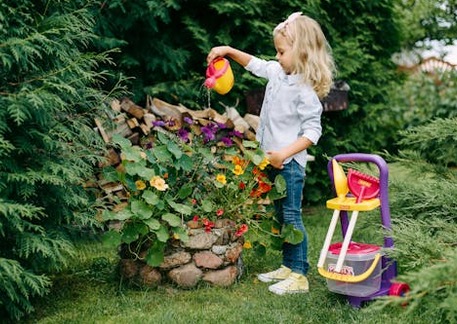
Grow a Garden
Shooting, chasing, exploring – hit video games tend to have themes that set the pulse racing.
One of the world’s most popular new titles, however, is about something considerably more sedate – gardening.
Grow a Garden involves players slowly developing a little patch of virtual land. It’s something that, earlier this month, more than 16m people – many of them children – chose to spend their weekend doing.
That smashed a record for concurrent players set by the somewhat more adrenalin-filled Fortnite.
What is it about this plant-growing simulation that has got so many people hooked – and could it persuade more people into real-life gardens?
What kind of games do you think of when you think of procedural content generation?
For me, at least, a handful of especially well-known games spring immediately to mind. Minecraft. No Man’s Sky. Terraria, and its sorta-but-not-really successor Starbound.
In all of these games, the main thing that’s procedurally generated is the terrain. As a player, you can keep moving indefinitely in any direction, and the game will procedurally generate new chunks of terrain as needed to fill in the blanks.
Because the experience of playing these games depends heavily upon procedurally generated content, and because these games are strongly associated with PCG in the popular imagination, I think it makes sense to consider them as a genre of PCG-based games. Specifically, let’s refer to them as procedural-terrain exploration games.
Judging purely by their continuing popularity, these games are undoubtedly successful. Lately, though, something about them has been bothering me, and in the long term, they seem to be completely incapable of holding my interest. When I take my first tentative steps into one of these games, its infinite world seems alive with possibilities – but gradually, as I become more accustomed to the game, playing starts to feel more and more like a repetitive grind.
In this post, I’ll try to explain what exactly it is about procedural-terrain exploration games that makes me feel this way. At the same time, I’ll also try to sketch out my vision for a possible alternative genre of PCG-based games. My eventual hope is that, in moving away from the genre conventions of the procedural-terrain exploration game, we might stumble upon some potential solutions to the problems facing PCG-based games as they currently exist.
We could identify the plant if we could smell it, Nozedar remarks, but nothing smells of anything in Yaughton. This isn’t, of course, a real place: it’s the setting for the video game Everybody’s Gone to the Rapture. I’ve brought Nozedar here (or rather, asked her to watch me play over streaming app Twitch) in response to her book, Foraging With Kids, which aims to help children “put down their screens, get outside and engage with nature”.
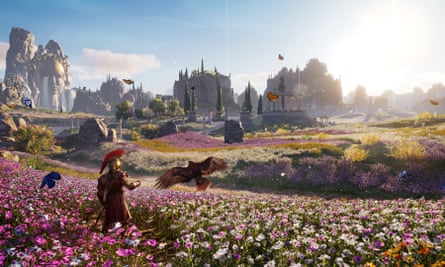
The Fields of Elysium … Assassin’s Creed: Odyssey. Photograph: Ubisoft
It’s a timely aim: adults have always worried about sheltered or deprived children missing out on the benefits of green spaces, but especially now, under lockdown conditions, when we have never been more reliant on our devices. Still, might video game settings such as these meet us halfway, by teaching young people about plants they can’t get access to? Nozedar is broadly impressed by Yaughton’s flora. “Their intention hasn’t been to educate, and the fact that they’ve bothered to make the plants look this realistic is really brilliant,” but she doesn’t think it stands alone. She suggests that parents might use it as a teaching tool by challenging children to work out what the game gets wrong. “It’s quite empowering for kids if they can spot something that isn’t accurate – it shows discernment.”
Today’s video games teem with flora and fungus, from the mimosa trees of Assassin’s Creed: Odyssey to the Colombian rainforests of Hitman 2, but they seldom encourage real curiosity about plants. Mostly, they are either generic “green herb” healing items or wodges of non-interactive scenery: only a handful, including farming simulations such as Stardew Valley, build meaningful activities around them. This obscures their educational potential and the immense artistry that goes into representing such complex organic objects within a limited computer memory budget.
Color Theory Through Digital Experimentation
You know that paralyzing fear when you’re standing in the garden center, holding two plants and wondering if they’ll look amazing together or like a complete disaster? Yeah, that used to be me every single time. Garden games completely eliminated that anxiety. I spent entire evenings last winter playing around with color combinations that I never would’ve dared try in real life. Purple and orange? Sounds terrible, right? Wrong! In the right proportions, it’s absolutely stunning. The games give you instant visual feedback, so you can see immediately whether something works or whether it looks like a toddler’s art project gone wrong. I discovered that colors I’d written off as “never going to work” actually create incredible focal points when you balance them properly. Now, when I’m planning my real garden, I have this whole mental catalog of color combinations that I know work. The confidence boost is incredible – I’m no longer second-guessing every plant choice.
How your garden grows
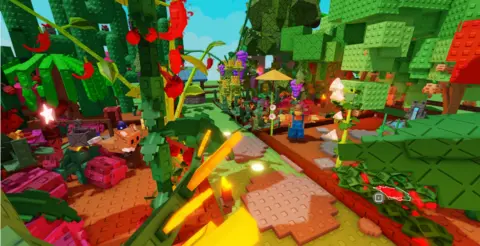
Players of Grow a Garden, which features on the online gaming platform, Roblox, do exactly what the title suggests.
When I gave the game a go, I was presented with my own little brown patch of land.
To the sounds of some relaxing music, I bought seeds from the local shop, and watched them as they grew, something that continues even when you are offline.
Once your garden produces a harvest, you can sell your items. You can also steal from the gardens of others.
“It’s a really fun game,” says eight-year-old Eric Watson Teire, from Edinburgh. He and his 10-year-old brother, Owen, are massive fans.
Eric said “a lot” of his friends at school are playing it too.
“We can do competitions with each other – like, who’s got the most Sheckles [the in-game currency], who’s got the best plant.”
They are not the only ones. According to Roblox, the game has had about 9bn visits since it was created in March. It says 35% of the Garden’s players up until now have been aged 13 and under.
In this sense, the exploration game format imposes strict limitations on the character stories that a game can tell. Any change that occurs in a non-player character must be made evident to the player within the scope of a single encounter. Is it any surprise, then, that the most common form of change for characters to undergo in exploration games is both instantaneously visible and clearly binary?
The player can use a variety of tools to exert influence on the garden, but the ultimate outcome is always shaped by forces entirely outside of the player’s control. You can water certain flowers and plant certain seeds, but the weather doesn’t always agree with your choices of which plants to favor. You can try to plant pink flowers over here and purple flowers over there, but don’t be too surprised if – over the course of a few generations – the indiscriminate activity of pollinators erodes the sharp distinction between the two until it falls entirely away.
To play a gardening game is to become intimately familiar with the story of a bounded space as it changes over time. The player’s attention remains fixed on a single, gradually evolving system; it is not scattered throughout a vast world whose individual parts are uniformly disconnected. To know why a garden looks the way it does today is to understand not only the histories of its individual parts, but also of the relationships between them, both past and present. In a garden, each individual flower becomes a character in an ongoing story, with a personal narrative arc all its own.
Professor Alexandre Antonelli, director of science at London’s Kew Gardens, would like to collaborate with a developer on a game featuring Kew’s gigantic collection of plant species (you can hear about the centre’s more unusual crops on the Unearthed podcast). Antonelli has spent years struggling to interest his tech-loving son in botany, only to stumble on unexpected common ground in the plant life of Rockstar’s cowboy adventure Red Dead Redemption 2. The game features 43 species, including oregano, which grows in Antonelli’s garden. “After he had collected it in the game, I said oh, if you want some oregano we can go pick it up right now. And he got really excited.”
In particular, Antonelli would love to make a plant-spotting version of augmented reality game Pokémon Go, in which you track monsters through your phone camera. “There’s an app called iNaturalist, where you can take a photo of a plant or animal and there’s machine learning to identify the species. It’s a fantastic thing to do with your phone but I think what we’ve been lacking is the game part, because especially for younger people, there must be some kind of reward.”

Should there be a plant-spotting version of Pokémon Go? Photograph: Wachirawit Iemlerkchai/Alamy Stock Photo
Motivating people across the globe to create records of local species might also help scientists rescue endangered plants, he adds. “With climate change and other problems, we really need to know where species are. It’s basic knowledge that we’re lacking today, and it’s much more expensive to send a professor, such as myself, somewhere to make an inventory.”
Gamifying anything risks making the reward the point of the process, and it’s easy to imagine users of a plant-spotting augmented reality game destroying plant habitats in their enthusiasm, much as Pokémon Go players have gridlocked high streets. Antonelli draws a comparison with the older hobby of collecting and pressing plants, that led to some species becoming threatened. There’s also a tragic irony to the idea of turning computer simulations, that are made and played at considerable environmental expense, into a repository for endangered flora.
Conclusion: Growing a Thriving Garden Starts With the Right Care
In conclusion, growing a successful garden comes down to understanding the essentials — healthy soil, proper watering, adequate sunlight, and consistent care. Whether you’re starting small with a few plants or building a larger outdoor space, focusing on these core elements helps create a vibrant and sustainable garden. Simple practices like choosing the right plants, improving soil with organic matter, and adapting to seasonal changes can make a significant difference in plant health and growth. With patience, planning, and the right approach, anyone can transform their outdoor space into a flourishing garden that brings both beauty and satisfaction year-round.